


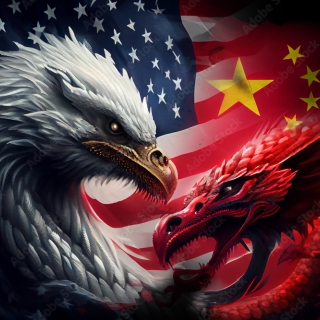
No country should bypass international laws to authorise resource exploration in the seabed, China's foreign ministry said on Monday, following a report of U.S. plans to stockpile deep-sea metals to counter China's dominance in the sector.
The Trump administration is drafting an executive order to enable stockpiling of deep-sea metals found on the Pacific Ocean seabed to counter China's dominance of battery minerals and rare earth supply chains, the Financial Times reported on Saturday, citing people familiar with the matter.
The stockpile would "create large quantities ready and available on U.S. territory to be used in the future," in case of a conflict with China that might constrain imports of metals and rare earths, the report said.
China has placed some rare earth elements under export restrictions in retaliation to U.S. President Donald Trump's steep tariffs on Chinese goods, potentially cutting the U.S. off from critical minerals vital to everything from smartphones to electric car batteries.
Following the report, the Chinese foreign ministry said that under international law, the seabed and its resources "are the common heritage of mankind."
"Exploration and exploitation of mineral resources in the international seabed area must be conducted in accordance with the United Nations Convention on the Law of the Sea and within the framework of the International Seabed Authority," the ministry said in a statement.
China produces around 90% of the world's refined rare earths, a group of 17 elements used across the defense, electric vehicle, clean energy and electronics industries. The U.S. imports much of its rare earths, which come largely from China.
Source: Investing.com
Renewed tensions between the United States and Russia have resurfaced following an incident involving an oil tanker, sparking market concerns about potential disruptions to global energy supplies. Was...
According to a report from the US Department of Labor (DOL) released on Thursday, the number of Americans filing new applications for unemployment insurance rose to 208,000 for the week ending January...
Geopolitical issues have heated up again after statements and political signals from the United States sparked speculation about a possible US takeover of Greenland. Although no concrete action has be...
Private employment rose less than economists expected in December, according to the ADP report. Private employment rose 41,000 (Estimate +50,000) in December, compared with a revised -29,000 in Novem...
Greenland is not only a strategic location, but also a world-class mineral repository. The island holds vast reserves of rare earth elements (REEs), essential for modern technology. These minerals are...
Oil prices stabilized on Thursday (February 12th), as the market reassigned a risk premium to US-Iran tensions despite US inventory data showing swelling domestic supplies. This movement confirms one thing: geopolitical headlines are still more...
Gold prices weakened slightly on Thursday (February 12th), as more solid US employment data reduced market confidence in an imminent Federal Reserve interest rate cut. The strong employment data prompted market participants to shift expectations of...
The Hang Seng Index reversed its downward trend in Hong Kong on Thursday (February 12th), weakening by around 0.9% to around 27,000 after a strong session earlier. This decline halted the momentum of the short term rally, as investors began to...